

A Man In The Rain
| Pelting Human | |
|---|---|
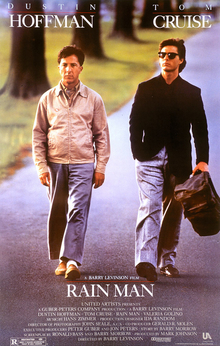 Theatrical release poster by John Alvin | |
| Directed by | Barry Levinson |
| Screenplay past |
|
| Story by | Barry Morrow |
| Produced by | Mark Johnson |
| Starring |
|
| Cinematography | John Seale |
| Edited by | Stu Linder |
| Music by | Hans Zimmer |
| Product |
|
| Distributed by | MGM/UA Communications Co. |
| Release appointment |
|
| Running time | 134 minutes[1] |
| Country | United States[i] |
| Language | English |
| Budget | $25million[ii] |
| Box role | $354.8million[2] |
Rain Man is an 1988 American route drama pic directed past Barry Levinson and written by Barry Morrow and Ronald Bass. It tells the story of annoying, selfish young wheeler-dealer Charlie Babbitt (Tom Cruise), who discovers that his estranged male parent has died and ancestral virtually all of his multimillion-dollar estate to his other son, Raymond (Dustin Hoffman), an autistic savant, of whose being Charlie was unaware. Charlie is left with only his father's honey vintage car and rosebushes. Valeria Golino also stars every bit Charlie's girlfriend Susanna. Morrow created the character of Raymond later on meeting Kim Peek, a existent-life savant; his characterization was based on both Peek and Bill Sackter, a good friend of Morrow who was the bailiwick of Beak (1981), an before film that Morrow wrote.[3]
Rain Human premiered at the 39th Berlin International Pic Festival, where it won the Golden Conduct, the festival's highest prize.[4] It was theatrically released by MGM/UA Communications Co. in the Us on December 16, 1988, to critical and commercial success, grossing $354.eightmillion, on a $25 million budget, becoming the highest-grossing flick of 1988, and received a leading eight nominations at the 61st Academy Awards, winning 4 (more than than whatever other film nominated); Best Picture, Best Manager, Best Role player (for Hoffman), and Best Original Screenplay.[5]
Every bit of 2022[update], Pelting Human being is the first and just film to win both the Berlin's highest achievement and Academy Award for Best Picture at the same year. It was also the last MGM title to exist nominated for Best Moving-picture show until Licorice Pizza (2021) 33 years later.[6]
Plot [edit]
Collectibles dealer Charlie Babbitt is in the heart of importing iv grey market Lamborghinis to Los Angeles for resale. He needs to evangelize the cars to impatient buyers, who have already made downwardly payments, in order to repay the loan he took out to buy them, but the EPA is property the cars at the port because they accept failed emissions tests. Charlie directs an employee to lie to the buyers while he stalls his creditor.
When Charlie learns that his estranged begetter Sanford Babbitt has died, he and his girlfriend Susanna travel to Cincinnati in order to settle the estate. He inherits only a group of rosebushes and a classic 1949 Buick Roadmaster convertible over which he and his father clashed, while the balance of the $3meg manor is going to an unnamed trustee. He learns that the money is being directed to a local mental institution, where he meets his elder blood brother, Raymond, of whom he was unaware his whole life.
Raymond has autism and savant syndrome and adheres to strict routines. He has superb recollect, merely he shows trivial emotional expression except when in distress. Charlie spirits Raymond out of the mental establishment and into a hotel for the night. Susanna becomes upset with the style Charlie treats his blood brother and leaves him. Charlie asks Raymond's doctor, Dr. Gerald Bruner, for half the estate in exchange for Raymond'due south render, but Bruner refuses. Charlie decides to try to gain custody of his brother in lodge to get control of the money.
Subsequently Raymond refuses to fly to Los Angeles, he and Charlie resort to driving in that location instead. They brand slow progress because Raymond insists on sticking to his routines, which include watching The People's Court on television every day, getting to bed by xi:00 PM, and refusing to travel when information technology rains. He also objects to traveling on the interstate afterward they encounter a car accident. During the course of the journey, Charlie learns more about Raymond, including his ability to instantly perform circuitous calculations and count hundreds of objects at once, far beyond the normal range of human abilities. He also realizes Raymond had lived with the family as a child and was the "Rain Man", a comforting figure that Charlie had falsely remembered as an imaginary friend. Raymond had saved an infant Charlie from being scalded by hot bathwater one day, but their father had blamed him for most injuring Charlie and committed him to the institution, as he was unable to speak up for himself and correct the misunderstanding.
Charlie'south creditor repossesses the Lamborghinis, forcing him to refund his buyers' downwards payments and leaving him deeply in debt. Having passed Las Vegas, he and Raymond render to Caesars Palace on the Strip and devise a plan to win the needed money by playing blackjack and counting cards. Though the casino bosses obtain videotape bear witness of the scheme and enquire them to exit, Charlie successfully wins $86,000 to cover his debts and reconciles with Susanna, who has rejoined the brothers in Las Vegas.
Returning to Los Angeles, Charlie meets with Bruner, who offers him $250,000 to walk away from Raymond. Charlie refuses and says that he is no longer upset about being cutting out of his male parent's will, but he wants to take a relationship with his blood brother. At a meeting with a court-appointed psychiatrist, Raymond proves unable to decide for himself what he wants. Charlie stops the questioning and tells Raymond he is happy to have him as his brother. As Raymond and Bruner board a train to return to the institution, Charlie promises to visit in ii weeks.
Cast [edit]
- Dustin Hoffman every bit Raymond "Ray" Babbitt
- Tom Prowl every bit Charles "Charlie" Babbitt
- Valeria Golino equally Susanna
- Jerry Molen as Dr. Gerald Bruner
- Ralph Seymour every bit Lenny
- Michael D. Roberts as Vern
- Bonnie Hunt as Sally Dibbs
- Beth Grant as Female parent at Farm House
- Lucinda Jenney equally Iris
- Barry Levinson as Doctor
Production [edit]
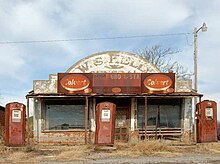
A now-abandoned gas station and general store in Cogar, Oklahoma was used in a scene from the moving-picture show. The Colvert sign has since been removed, revealing the full proper name of the concern.
In drafting the story for Pelting Human, Barry Morrow decided to base the Dustin Hoffman'due south character, Raymond Babbitt, off of his experiences with both Kim Peek and Pecker Sackter, 2 men who had gained notoriety and fame for their intellectual disabilities. Prior to the formulation of Pelting Man, Morrow had formed a friendship with the intellectually disabled Sackter, and in doing and so ended upwardly taking some situational aspects from his friendship and using them to help craft the relationship between Charlie and Raymond. Following the success of the made-for-Television set movie he had written about Sackter, Neb, Morrow met the notorious Kim Peek and was wildly intrigued by his Savant Syndrome. Initially going into the creation of the moving picture, Morrow was essentially unaware of the intricacies of the condition, as well equally of autism itself, deciding instead the movie was less about Raymond's intellectual inability and more about the relationship formed between Raymond and Charlie.[7]
Roger Birnbaum was the first studio executive to give the motion picture a dark-green calorie-free; he did then immediately after Barry Morrow pitched the story. Birnbaum received "special thanks" in the film's credits.[ citation needed ]
Real-life brothers Dennis Quaid and Randy Quaid were considered for the roles of Raymond Babbitt and Charles Babbitt.[eight] Agents at CAA sent the script to Dustin Hoffman and Bill Murray, envisioning Murray in the title role and Hoffman in the office somewhen portrayed past Prowl.[3] Martin Brest, Steven Spielberg and Sydney Pollack were directors besides involved in the film.[9] Mickey Rourke was as well offered a part just he turned it down.[10]
For a year prior to playing Raymond Babbitt, Hoffman prepared to portray Raymond'southward autism by seeking out and educating himself on other people with autism, peculiarly those with Savant Syndrome. Hoffman had some experience with disabled individuals prior to filming, having worked at the New York Psychiatric Institute when he was younger. Inspiration for the portrayal of Raymond Babbitt'southward mannerisms was drawn from a multitude of sources, including Kim Peek and the autistic brother of a Princeton football player with whom Hoffman was in touch with at the fourth dimension. Part of Hoffman'due south research into the role besides included in-person meetings with savant Kim Peek, wherein he would find and mimic Peek's deportment in order to attempt to requite an authentic portrayal at what an individual with Savant Syndrome might act like. His mimicry of Peek'southward Savant Syndrome was deemed a poor fit for the graphic symbol past Hoffman, resulting in Hoffman deciding to brand Babbitt not simply a human being with Savant Syndrome, but also a man with autism.[7] This conclusion was i that proved to only further the misunderstanding of autism spectrum disorder amongst the general public: though autism is, in itself, a varying status with numerous ways in which it is characterized, having both autism and Savant Syndrome is an incredibly rare occurrence.[xi] Yet, audiences were swayed into thinking that most autistic individuals were intellectually capable of savant abilities largely past the Hoffman's portrayal of Raymond Babbitt.
Principal photography included nine weeks of filming on location in Cincinnati and throughout northern Kentucky.[12] Other portions were shot in the desert nearly Palm Springs, California.[13] : 168–71
At that place was originally a dissimilar ending to the movie drafted by Morrow which differed from Raymond going back to the institution. Morrow ultimately decided to driblet this catastrophe in favor of Raymond returning to the institution, as he felt the original ending would not have stuck with the viewers as effectively as the revised catastrophe did.[7]
Nigh all of the principal photography occurred during the 1988 Writers Guild of America strike; 1 key scene that was affected by the lack of writers was the movie's final scene.[3] Bass delivered his concluding draft of the script but hours before the strike started and spent no time on the ready.[9]
Release [edit]
Box role [edit]
Rain Man debuted on Dec 16, 1988, and was the second highest-grossing film at the weekend box office (behind Twins), with $7million.[14] Information technology reached the first spot on the Dec 30 – Jan 2 weekend, finishing 1988 with $42million.[xv] The film would end upwardly equally the highest-grossing U.Southward. movie of 1988 by earning over $172million. The pic grossed over $354million worldwide.[ii]
Disquisitional reception [edit]
On review aggregator website Rotten Tomatoes the picture show holds an approval rating of 89% based on 130 reviews, with an average rating of viii.1/x. The website's disquisitional consensus states: "This road-trip picture about an autistic savant and his callow brother is far from seamless, simply Barry Levinson's direction is impressive, and strong performances from Tom Cruise and Dustin Hoffman add to its appeal."[16] Metacritic assigned the moving-picture show a weighted average score of 65 out of 100 based on 18 critics, indicating "generally favorable reviews".[17] Audiences polled past CinemaScore gave the film an average form of "A" on an A+ to F scale.[18]
Vincent Canby of The New York Times chosen Rain Man a "becomingly modest, decently thought-out, sometimes funny movie"; Hoffman's performance was a "display of sustained virtuosity . . . [which] makes no lasting connections with the emotions. Its end result depends largely on one'south susceptibility to the sight of an role player acting nonstop and extremely well, but to no particularly urgent dramatic purpose."[19] Canby considered the "flick's true fundamental graphic symbol" to be "the confused, economically and emotionally desperate Charlie, beautifully played by Mr. Cruise."[19]
Amy Dawes of Variety wrote that "one of the yr's most intriguing film bounds ... is given uneven, slightly off-target treatment"; she called the road scenes "hastily, loosely written, with much extraneous screen time," but admired the last third of the flick, calling it a delineation of "two very isolated beings" who "discover a common history and deep attachment."[twenty]
One of the moving picture's harshest reviews came from New Yorker magazine critic Pauline Kael, who said, "Everything in this movie is fudged ever so humanistically, in a perfunctory, depression-pressure way. And the picture has its effectiveness: people are crying at it. Of grade they're crying at it—it'south a piece of moisture kitsch."[21]
Roger Ebert gave the picture iii and a half stars out of four. He wrote, "Hoffman proves again that he almost seems to thrive on impossible acting challenges...I felt a sure love for Raymond, the Hoffman graphic symbol. I don't know quite how Hoffman got me to practice it."[22] Gene Siskel also gave the movie three and a half stars out of four, singling out Cruise for praise, "The forcefulness of the pic is really that of Cruise's functioning...the combination of two superior performances makes the movie worth watching."[23]
Rain Man was placed on 39 critics' "ten best" lists in 1988, based on a poll of the nation'southward acme 100 critics.[24]
Accolades [edit]
The film is recognized past American Film Institute in these lists:
- 2006: AFI's 100 Years...100 Cheers - #63
Legacy [edit]
After its release in 1988, Rain Man saw funding for medical research and diagnoses of individuals for autism spectrum disorder increase tenfold. Rain Man is a pic famous in particular for its portrayal of a human being with both autism and Savant Syndrome, leading much of its viewing audience to empathize the intellectual capabilities of those with autism in an wrong way.[7]
The character of Raymond Babbitt has been criticized for fitting into the stereotype of the "Magical/Savant" autistic character. Characters like these are portrayed as having an otherworldly intellectual ability that, rather than disable them from living a "normal" life, instead assists them in a about magical way, causing those effectually them to exist in awe and wonder as to how a person might have this capability. While having Savant Syndrome is certainly a possibility for autistic individuals, information technology is incredibly rare.[11]
In popular culture [edit]
Rain Human being 'due south portrayal of the main graphic symbol'southward condition has been seen as creating the erroneous media stereotype that people on the autism spectrum typically have savant skills, and references to Rain Human, in particular Dustin Hoffman's performance, have become a popular autograph for autism and savantism. Conversely, Pelting Man has also been seen equally dispelling a number of other misconceptions about autism, and improving public awareness of the failure of many agencies to accommodate autistic people and make use of the abilities they do accept, regardless of whether they accept savant skills or not.[36]
The motion-picture show is besides known for popularizing the misconception that card counting is illegal in the The states.[37]
The Babbitt brothers appear in The Simpsons flavour 5 episode $pringfield. The film is mentioned in numerous other films such as Miss Congeniality (2000), 21 (2008), Tropic Thunder (2008) (in which Tom Cruise fabricated an advent), The Hangover (2009), Escape Room (2019), and as well in the television series Breaking Bad.
Raymond Babbitt was caricatured as a rain cloud in the animated episode of The Nanny, "Oy to the World". During the episode, Fran fixes up CC the Beastly Babcock with the Rain Man. He is portrayed as a deject of rain mumbling about weather patterns and beingness an excellent driver.
Qantas and airline controversy [edit]
During June 1989, at least fifteen major airlines showed edited versions of Rain Homo that omitted a scene involving Raymond'south refusal to fly, mentioning the crashes of American Airlines Flight 625, Delta Air Lines Flight 191, and Continental Airlines Flight 1713, except on Australia-based Qantas. Those criticizing this decision included moving picture director Barry Levinson, co-screenwriter Ronald Bass, and George Kirgo (at the time the President of the Writers Guild of America, Due west). "I think it'due south a key scene to the entire movie," Levinson said in a telephone interview. "That'southward why it's in there. It launches their entire odyssey beyond land – because they couldn't fly." While some of those airlines cited as justification avoiding having airplane passengers feel uncomfortable in sympathy with Raymond during the in-flight entertainment, the scene was shown intact on flights of Qantas, and commentators noted that Raymond mentions it as the only airline whose planes have "never crashed".[38] [39]
The picture is credited with introducing Qantas' prophylactic record to U.S. consumers.[40] [41] Withal, reverse to the claims made in the flick, Qantas aircraft have been involved in a number of fatal accidents since the airline'due south founding in 1920, though none involving jet aircraft, with the last incident taking place in Dec 1951.[42]
The Buick convertible [edit]
Two 1949 Roadmaster convertibles were used in the filming, one of which had its rear suspension stiffened to acquit the additional load of camera equipment and a cameraman. After filming completed, the unmodified car was caused by Hoffman, who had it restored, added information technology to his drove and kept information technology for 34 years. Hemmings Motor News reported that this car was auctioned in January 2022 past Bonhams at Scottsdale, Arizona and sold for $335,000.[43] The camera-conveying car was similarly caused past Barry Levinson, who a few years afterward had information technology restored past Wayne Carini of the Chasing Classic Cars television series.
Run into also [edit]
- Savant syndrome
References [edit]
- ^ a b c d "Rain Man (1988)". AFI Catalog of Feature Films. Archived from the original on November 5, 2018. Retrieved November 5, 2018.
- ^ a b c Rain Human at Box Office Mojo
- ^ a b c Barry Morrow's audio commentary for Rain Man from the DVD release.
- ^ "Berlinale: 1989 Prize Winners". berlinale.de. Archived from the original on June 9, 2019. Retrieved March 13, 2011.
- ^ a b "The 61st Academy Awards (1989) Nominees and Winners". oscars.org. Archived from the original on May ii, 2019. Retrieved July 31, 2011.
- ^ "MGM's Michael de Luca & Pam Abdy on Studio'due south First In-Firm Best Picture Oscar Nomination in 33 Years, Being "Mildly Psychotically Obsessive" About Movies & What's Alee – Q&A". February 9, 2022.
- ^ a b c d "Pelting Human being at 30: damaging stereotype or 'the best thing that happened to autism'?". the Guardian. December xiii, 2018. Retrieved May nine, 2022.
- ^ Mell, Eila (Jan 24, 2015). Casting Might-Take-Beens: A Moving-picture show past Flick Directory of Actors Considered for Roles Given to Others. ISBN9781476609768.
- ^ a b Bass' audio commentary for Pelting Man from the DVD release.
- ^ "Mickey Rourke: a life in moving picture". Fourth dimension Out. Archived from the original on May 9, 2018. Retrieved September 10, 2015.
- ^ a b Prochnow, Alexandria (2014). "AN Assay OF AUTISM THROUGH MEDIA REPRESENTATION". ETC: A Review of General Semantics. 71 (two): 133–149. ISSN 0014-164X.
- ^ Alter, Maxim; Maxwell, Emily (February 28, 2014). "So and Now: A look dorsum at 'Pelting Man' in Cincinnati and Northern Kentucky". WCPO . Retrieved January 10, 2022.
- ^ Niemann, Greg (2006). Palm Springs Legends: creation of a desert oasis. San Diego, CA: Sunbelt Publications. p. 286. ISBN978-0-932653-74-1. OCLC 61211290. (hither for Table of Contents Archived March 4, 2016, at the Wayback Machine)
- ^ "Weekend Box Office: December xvi–18, 1988". Box Function Mojo. Archived from the original on September 9, 2017. Retrieved April xx, 2020.
- ^ "Weekend Box Office: December 30 – January two, 1988". Box Part Mojo. Archived from the original on September 24, 2018. Retrieved April xx, 2020.
- ^ "Rain Man (1988)". Rotten Tomatoes. Fandango Media. Archived from the original on June 24, 2022. Retrieved August iii, 2022.
- ^ "Pelting Human being Reviews". Metacritic. CBS Interactive. Archived from the original on March 11, 2018. Retrieved March ane, 2018.
- ^ "Cinemascore :: Movie Title Search". December 20, 2018. Archived from the original on Dec 20, 2018. Retrieved July 27, 2020.
- ^ a b "December 1988 review from The New York Times".
- ^ Pelting Man Archived Feb 28, 2009, at the Wayback Machine, Variety, December fourteen, 1988
- ^ Kael, Pauline. Rain Man at Metacritic , The New Yorker (Feb. 1989)
- ^ Rain Man review Archived Jan 20, 2021, at the Wayback Machine Ebert, Roger
- ^ Siskel, Gene (December xvi, 1988). "Cruise'southward Perforrmance Gives 'Pelting Man' Strength". Chicago Tribune. Retrieved February 21, 2021.
- ^ "100 Motion-picture show Critics Tin't Be Incorrect, Tin can They? : The critics' consensus choice for the 'all-time' movie of '88 is . . . a documentary!". Los Angeles Times. Jan viii, 1989. Archived from the original on March 8, 2021. Retrieved May 9, 2020.
- ^ "The ASC Awards for Outstanding Achievement in Cinematography". Archived from the original on Baronial 2, 2011.
- ^ "PRIZES & HONOURS 1989". Berlin International Film Festival . Retrieved July 10, 2021.
- ^ "BAFTA Awards: Film in 1990". BAFTA. 1990. Retrieved September 16, 2016.
- ^ "The 1990 Caesars Ceremony". César Awards. Retrieved July x, 2021.
- ^ "Chicago Film Critics Awards – 1988–97". Chicago Motion-picture show Critics Association. Archived from the original on Apr 22, 2016. Retrieved July 21, 2015.
- ^ "41st DGA Awards". Directors Lodge of America Awards . Retrieved July 10, 2021.
- ^ "Rain Man – Golden Globes". HFPA . Retrieved July 10, 2021.
- ^ "KCFCC Accolade Winners – 1980-89". December 14, 2013. Retrieved July 10, 2021.
- ^ "Past Awards". National Social club of Picture show Critics. Dec 19, 2009. Retrieved July v, 2021.
- ^ "1988 New York Motion-picture show Critics Circle Awards". Mubi . Retrieved July 10, 2021.
- ^ "Awards Winners". wga.org. Writers Society of America. Archived from the original on December five, 2012. Retrieved June 6, 2010.
- ^ Treffert, Darold. "Rain Human, the Movie/Pelting Man, Existent Life". Archived from the original on August 27, 2015. Retrieved September 29, 2014.
- ^ Rose, I. Nelson; Loeb, Robert A. (1999). Blackjack and the Police. Rge Pub. ISBN978-0-910575-08-ix.
- ^ "Airlines Cut Scene From 'Rain Homo'". The New York Times. June 29, 1989. Archived from the original on June 13, 2015. Retrieved June 6, 2015.
- ^ Weinstein, Steve (June 29, 1989). "Uneasy Airlines Get Terminal Cut on 'Pelting Man'". Los Angeles Times. Archived from the original on June 16, 2015. Retrieved June half-dozen, 2015.
- ^ Kamenev, Marina (Nov 24, 2010). "Qantas: Airline Safety'due south Gilt Child No More?". Time. Archived from the original on May 24, 2015. Retrieved June 6, 2015.
- ^ "Is Qantas still the world's safest airline?". News.com.au. Jan seven, 2014. Archived from the original on January 7, 2014. Retrieved June vi, 2015.
- ^ Palmer, Brian (November one, 2011). "Is Qantas The World's Safest Airline?". Slate. Archived from the original on May 24, 2015. Retrieved May 5, 2022.
- ^ Symes, Steven (January 31, 2022). "Rain Homo Buick Roadmaster Sells For $335,000". motorious.com . Retrieved Feb one, 2022.
 , The New Yorker (Feb. 1989)
- ^ Tied with Martin Landau for Tucker: The Human and His Dream and Dean Stockwell for Married to the Mob.
External links [edit]

Wikiquote has quotations related to Rain Man .

A Man In The Rain,
Source: https://en.wikipedia.org/wiki/Rain_Man
Posted by: jewellcracenduch.blogspot.com
0 Response to "A Man In The Rain"
Post a Comment